Euro Nymphing Basics for Colorado Rivers
For many anglers chasing Colorado's elusive trout, the constant battle with drag, the frustration of missed strikes, and the sheer challenge of getting a delicate nymph down to the feeding zone in swift currents can feel like an uphill climb. Traditional indicator nymphing often struggles in our highly technical, varied rivers, leaving you wondering if you're even presenting your fly correctly. This comprehensive guide is here to unravel the mysteries of Euro nymphing, offering a powerful, direct approach that has revolutionized how anglers effectively fish the diverse waters of Colorado, from our renowned tailwaters to our wild freestone streams.
What Exactly Is Euro Nymphing and Why It's Perfect for Colorado
Euro nymphing, often referred to as tight-line nymphing or contact nymphing, isn't just a fancy new technique; it's a fundamental shift in how you approach sub-surface fishing. Forget the bobber bouncing along the surface, hiding subtle takes – this method emphasizes a direct, uninhibited connection to your flies, allowing you to feel every bump, tic, and subtle interruption that signals a trout's interest. It’s a technique born out of competitive fly fishing in Europe, designed to maximize efficiency and catch rates in challenging river conditions.
The Core Principle: Direct Line Contact and Strike Detection
At its heart, Euro nymphing is all about maintaining constant, direct contact with your flies as they drift through the water column. Instead of relying on a buoyant indicator, your highly visible leader, or "sighter," becomes your primary strike detector. You hold your rod tip high, keeping as much line off the water as possible, and actively lead your flies through the current. This close connection means that when a trout mouths your nymph, even the slightest hesitation or twitch in your sighter translates into an immediate visual cue, allowing for lightning-fast hook sets. This sensitivity is crucial in waters where trout can be incredibly picky and takes can be almost imperceptible.
Why Traditional Indicator Nymphing Can Fall Short Here
While indicator nymphing has its place, especially in slower, uniform currents or when presenting very light rigs, it often struggles in the dynamic environments typical of Colorado rivers. The inherent drag created by an indicator and the slack in the line between the indicator and the flies can significantly reduce your ability to detect strikes. Imagine trying to feel a feather-light tap on your fly when it's suspended beneath a buoyant piece of foam, with several feet of sag in your line – it's incredibly difficult. Furthermore, indicators can hinder your ability to get heavily weighted flies down quickly through strong currents, especially in deeper pockets or runs. This is where the direct approach of Euro nymphing really shines, cutting through those common frustrations. For those struggling with this, exploring different Nymphing Techniques for Colorado Tailwaters can be very enlightening.
Advantages for Colorado's Diverse River Systems
Colorado's rivers present a unique set of challenges and opportunities. We have everything from the incredibly clear, highly technical tailwaters below dams – like the Fryingpan River or the Blue River – to robust, freestone rivers like the Arkansas or the Colorado River itself. These waters often feature complex current seams, deep pockets, swift riffles, and highly educated trout. Euro nymphing excels in these scenarios because it allows for precise depth control, superior drift management, and unparalleled strike detection. You can quickly adjust your drift to match varying current speeds, ensuring your flies remain in the most productive feeding lanes for longer, without being swept away by conflicting currents. This is particularly advantageous when fishing Colorado's Gold Medal Waters Explained, where accuracy and stealth are paramount.
Essential Gear for Your Colorado Euro Nymphing Setup
Stepping into Euro nymphing often means a slight adjustment to your gear, but don't let that intimidate you. You don't necessarily need to completely overhaul your entire fly fishing arsenal. Many anglers start with a few key additions and adapt what they already have. The goal is to maximize sensitivity, maintain light line control, and effectively present your flies.
Rods, Reels, and Specialized Lines You'll Need
The heart of a Euro nymphing setup is usually a longer, lighter rod. Think 10 to 11 feet in length, typically in a 2 to 4-weight. This extra length provides crucial reach for keeping line off the water, managing complex drifts, and cushioning light tippets when fighting fish. A longer rod also acts as a better lever, allowing you to control your flies with precision. Brands like Moonshine Rod Co., Orvis, or Sage offer excellent rods designed specifically for Euro nymphing. As for reels, you simply need something to balance your longer rod and hold your specialized line. A lightweight reel with a smooth drag is ideal; it doesn't need to be expensive.
The biggest change comes with the fly line. Traditional fly lines are too heavy and create too much sag for effective Euro nymphing. Instead, specialized Euro nymphing lines are incredibly thin and lightweight, often just a level monofilament or a very thin PVC-coated line that meets FIPS Mouche competition standards. These lines are designed to have minimal weight and diameter, reducing sag and maximizing sensitivity. You'll attach a long, custom-built leader to this line, which will do all the work of turning over your nymphs.
The Importance of Leaders and Sighters
The leader is arguably the most critical component of your Euro nymphing rig. It's typically much longer than a standard fly fishing leader, ranging from 15 to 25 feet, and is constructed to be nearly weightless. A standard setup involves a short butt section of monofilament or braided line, followed by a long section of colored monofilament – your "sighter." This sighter is often multi-colored (e.g., alternating fluorescent orange and chartreuse) to make even the slightest movement visible against varying backgrounds and light conditions. Below the sighter, you'll attach your tippet rings, followed by your tippet, where your flies will be tied. This construction allows for a seamless transfer of energy and incredible sensitivity to any subtle takes. Learning How to Set Up a Nymph Rig for a Deep Tailwater Run is foundational for success here.
For example, you might start with a 20lb monofilament butt section, splice on a 10-15 foot section of specialized multi-colored sighter material (which you can often find pre-made or in bulk spools on sites like Amazon), then tie on a small tippet ring. From there, you'll run your desired tippet strength – usually 5x to 7x – down to your flies. The lighter the tippet, the more natural the drift, but also the more prone to breaking on a big Colorado trout.
Selecting Effective Nymph Patterns for Colorado
When it comes to nymphs for Colorado, the key is variety in weight, profile, and color. Unlike dry fly fishing where exact imitations are often critical, nymphing often benefits from a "generalist" approach, presenting patterns that broadly mimic common aquatic insects. However, having specific patterns that imitate major food sources in Colorado rivers will significantly increase your success.
Consider patterns like:
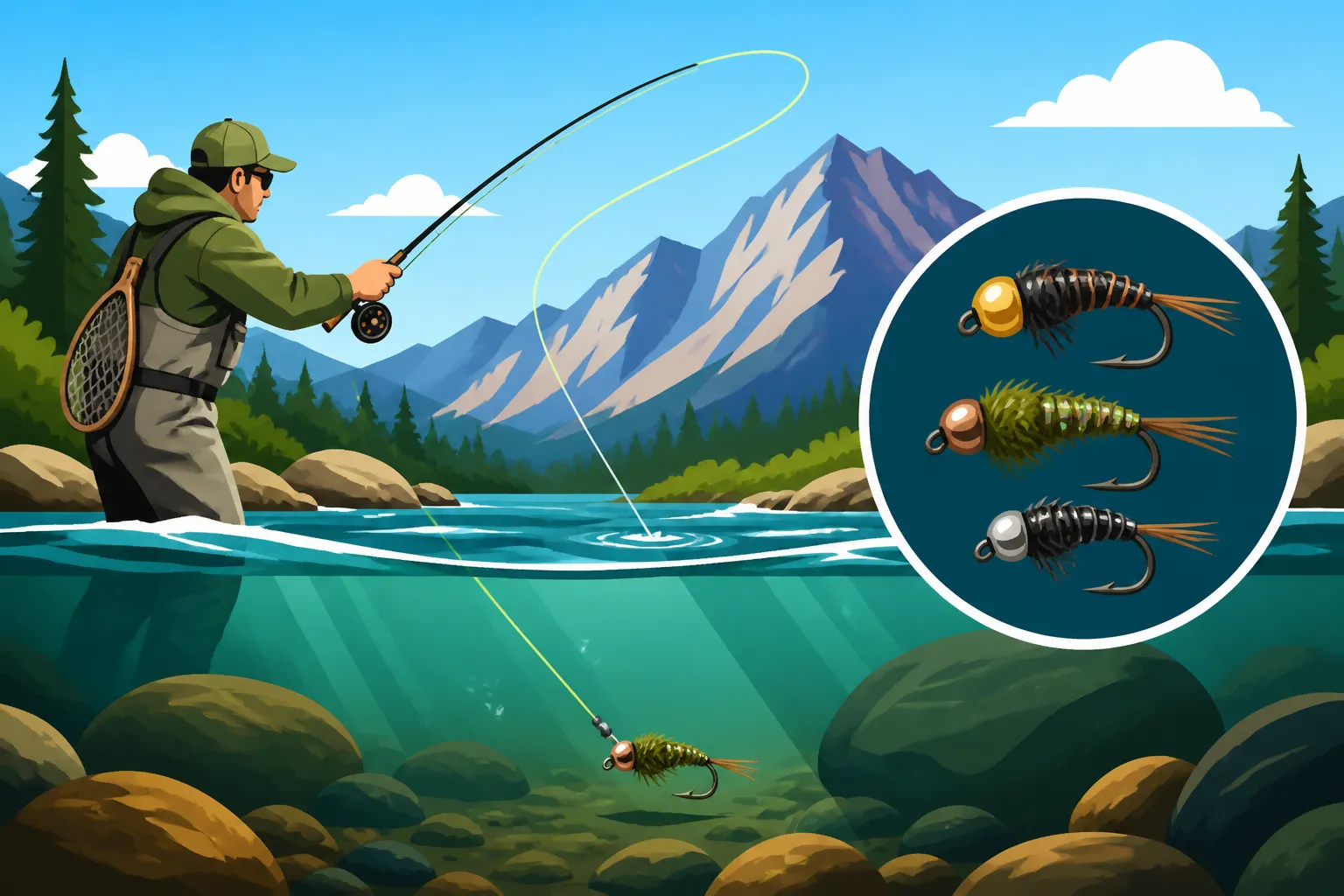
- Perdigons: These sleek, thin-profiled, often tungsten-beaded nymphs sink like a rock and are fantastic for getting down quickly in fast water. They come in various colors and sizes and are a staple for Euro nymphers.
- Pheasant Tail Nymphs: A classic for a reason, the Pheasant Tail imitates a wide range of mayflies and caddis larvae. Varying the bead size can help with depth control.
- Hare's Ear Nymphs: Another versatile pattern, effective for caddis and mayflies, offering a slightly chunkier profile.
- Stonefly Nymphs: Especially important on larger freestone rivers, patterns like Pat's Rubber Legs or 20 Inchers can imitate the large stoneflies that Colorado trout love.
- Midge Patterns: In the colder months or on clear tailwaters, tiny midge larvae and pupae patterns, often in sizes 18-24, are absolutely essential. Zebra Midges and Bloodworm patterns are consistent producers.
Having a good selection of tungsten-beaded nymphs, often in sizes 12-20, will give you the versatility to adapt to different depths and currents. You can even buy pre-weighted nymph assortments on Amazon that are great for getting started. Remember, often it's not just the pattern, but how you present it that matters most.
Mastering the Fundamentals of the Euro Nymphing Cast and Drift
Euro nymphing is less about casting distance and more about precision, line control, and maintaining that all-important direct connection to your flies. It's a method that prioritizes stealth and efficiency, allowing you to dissect a piece of water with incredible accuracy.
The Forward Tuck Cast: Getting Your Flies Down Fast
The Euro nymphing cast is often a short, controlled "tuck cast." Instead of a wide, sweeping motion, you'll use a more compact, vertical stroke. The idea is to lob your weighted nymphs in a way that they land first on the water, effectively "tucking" your leader and flies into the current. This action helps them sink rapidly through the water column, minimizing the time they spend near the surface where they are most prone to drag.
To execute a tuck cast, keep your rod tip fairly low to the water as you begin your forward stroke. Accelerate smoothly, then stop abruptly, pointing your rod tip towards your target. The momentum of the weighted flies should carry them forward and down, allowing them to land before your sighter. This technique ensures your flies start their drift at the correct depth almost immediately, which is crucial in fast, deep Colorado runs. Practice this cast to get a feel for how your specific rig behaves.
Maintaining a Tight Line and Controlling Your Drift
Once your flies are in the water, the real work begins: maintaining a tight line and controlling your drift. This means keeping your rod tip high, often at a 45-degree angle or even higher, and following your flies with the rod tip as they move downstream. The goal is to keep any slack out of your line, allowing your sighter to act as a direct extension of your flies. You're essentially guiding your flies, rather than letting them fend for themselves.
Think of it like this: your rod tip, sighter, and flies should move together, as a single unit, down the river. If you see your sighter lagging or pulling unnaturally, you're experiencing drag. A good drift is smooth, natural, and matches the speed of the current where your flies are located. This active mending and tracking are what give Euro nymphing its incredible effectiveness, enabling you to present your flies in a hyper-realistic manner to often wary trout. When fishing for brown trout in Colorado, this level of precision can be the difference between a frustrating day and a memorable catch.
Understanding the "Hang" and When to Recast
One subtle but deadly aspect of Euro nymphing is the "hang." As your flies reach the end of their drift – often at the downstream edge of a run or a deeper pocket – don't immediately pull them out of the water. Instead, allow them to swing or "hang" for a moment, letting them rise slightly in the current. This upward movement often triggers a strike from a trout that has been following your flies or is simply reacting to what appears to be an escaping insect. Many strikes occur during this vulnerable "hang" phase.
Knowing when to recast is also key. If your flies are no longer drifting naturally, if your sighter is showing excessive drag, or if you've explored a section of water thoroughly without a take, it's time to pick up your flies and present them again. The efficiency of Euro nymphing lies in its ability to quickly and repeatedly deliver flies to specific spots, rather than long, meandering drifts that might only be effective for a small portion of their journey.
Key Techniques for Reading Water and Presenting Nymphs Effectively
Colorado rivers offer a complex tapestry of currents, depths, and holding lies. Being able to decipher these subtle clues is paramount to successful Euro nymphing. It's not enough to simply have the right gear; you need to understand where the fish are and how to get your flies to them in the most enticing way possible.
Identifying Prime Holding Lies and Current Seams
Trout, especially larger ones, are energy conservationists. They'll position themselves in places where they can expend minimal energy while still having access to a consistent food supply. This typically means fishing the "cushion" behind large rocks, in the slower water adjacent to fast current seams, or in the deeper parts of a run. In a classic freestone river like the Poudre, these spots are often clearly visible. You can read more about Reading Water on a Colorado Freestone River to hone your skills.
When Euro nymphing, your direct contact allows you to actively explore these areas. Instead of just floating over them, you can guide your flies right into the seam, maintaining depth and a natural drift. Look for changes in water color, depth, and surface tension – these are often indicators of structure or varying currents beneath the surface where trout are likely to hold. Don't overlook the obvious, but also seek out the subtle pockets and eddies that others might miss.
Adjusting Weight and Depth for Different Scenarios
One of the most powerful aspects of Euro nymphing is the ability to rapidly adjust the weight of your nymphs to match the depth and speed of the water. If your flies aren't reaching the bottom quickly enough, or if they're constantly snagging, it means you need to adjust your weight. You can achieve this by changing to heavier or lighter nymphs, or by adjusting the number of flies in your multi-nymph rig.
A common setup is a "point fly" (the heaviest fly at the bottom) and one or two "dropper flies" tied off tag ends above it. If you're fishing a very fast, deep run, your point fly might be a heavily weighted tungsten jig nymph (like a size 12 Perdigon with a 4mm bead), while your droppers are lighter. In shallower or slower water, you might use smaller, less weighted flies. The beauty is that you can quickly swap flies to fine-tune your depth and sink rate. For insights on appropriate weighting, consider What Split Shot Size Works Best in Fast Colorado Currents means for your Euro nymphing setup – often, tungsten beads replace split shot for efficiency.
Fishing Upstream and Cross-Current Strategies
Most Euro nymphing is done fishing upstream or slightly upstream and across. This allows you to present your flies to undisturbed fish and gives you the maximum amount of time to manage your drift and detect strikes as your flies come towards you. As your flies drift downstream, you'll walk slowly upstream, keeping pace with your flies and maintaining that tight line.
However, don't shy away from cross-current presentations, especially when targeting specific seams or pockets that are hard to reach directly upstream. With a longer rod, you can cast across the current and then "lead" your flies, allowing them to swing into the target zone while still maintaining contact. The key is to always be active, using your rod tip to guide the flies and eliminate any slack that could compromise your strike detection. It's a dance between the current, your flies, and your rod tip, constantly adjusting to create the most natural presentation possible.
Common Challenges and Troubleshooting for Colorado Euro Nymphers
While Euro nymphing is incredibly effective, it's not without its learning curve. Colorado's unpredictable weather and diverse water conditions can throw a wrench into any angler's plans. Understanding these common challenges and how to troubleshoot them will help you adapt and succeed on the water.
Dealing With Wind and Maintaining Contact
Wind is often the bane of any fly fisher, and for Euro nymphing, it can be particularly frustrating. Strong gusts can blow your lightweight leader off course, make casting difficult, and create unwanted slack, hindering your ability to detect strikes. When the wind picks up, there are a few strategies you can employ. First, try casting with the wind at your back if possible, using it to your advantage to propel your flies. If that's not an option, shorten your cast and focus on more compact, controlled movements. You might also consider slightly heavier flies to cut through the wind more effectively.
Another tactic is to lower your rod angle slightly, just enough to reduce the amount of leader exposed to the wind, but not so much that you lose contact with your flies. Sometimes, even a slight change in your body position – crouching low or using a bank as a windbreak – can make a significant difference. Remember, the core principle is contact, so any technique that helps maintain that connection in windy conditions is a win.
Avoiding Tangles and Snags in Complex Runs
One of the initial frustrations many Euro nymphers face is tangles, especially when first learning the casting stroke or when fishing multiple flies. The long leader and multiple nymphs can be a recipe for a bird's nest if not managed correctly. Practice your tuck cast to ensure your flies land cleanly and in line. When you retrieve your flies for a recast, do so smoothly, lifting them from the water rather than ripping them out, which can cause them to tangle.
Snags are an inevitable part of nymphing, especially when fishing near the bottom where trout feed. The advantage of Euro nymphing is that your direct contact often allows you to feel the snag before it's fully set, giving you a chance to gently lift your flies free. If you do get snagged, resist the urge to violently pull. Instead, point your rod directly at the snag, then pull straight back with a steady pressure. If that doesn't work, try changing your angle or even walking upstream or downstream to dislodge the flies. Having a good supply of tippet and a range of nymphs is always wise when tackling Colorado's snag-happy rivers.
Interpreting Subtle Strikes and Setting the Hook
This is where the magic of Euro nymphing truly comes alive – and also where the biggest learning curve often lies. Unlike the dramatic dunk of an indicator, Euro nymphing strikes are often incredibly subtle. It could be a slight hesitation in your sighter's drift, a subtle twitch, a momentary darkening, or even just a feeling of "weight" that wasn't there a moment ago. Your job is to train your eyes and hands to recognize these almost imperceptible cues.
The key to interpreting strikes is consistency in your drift. If your sighter is moving smoothly and naturally, any deviation is suspect. When you see or feel something unusual, don't hesitate – set the hook! A proper hook set for Euro nymphing is a quick, crisp upward or sideways sweep of the rod, enough to set the small, sharp hook without being overly aggressive and breaking your light tippet. You can learn more about How to Set the Hook on a Take in Fast Water to improve your technique. Many times, you'll set the hook on nothing but water, but the times you connect with a trout make it all worthwhile. Over time, your instincts will sharpen, and you'll be amazed at how many fish you were missing before.
Transitioning Your Euro Nymphing Skills to Different Colorado Waters
One of the greatest strengths of Euro nymphing is its versatility. While it might seem tailored for specific conditions, the underlying principles of contact and precise presentation are adaptable to almost any river environment in Colorado. Learning to fine-tune your approach for different water types will make you a more well-rounded and successful angler.
Applying Techniques to Gold Medal Tailwaters
Colorado's tailwaters, like the Fryingpan below Ruedi Reservoir or the Blue River in Silverthorne, are often designated as "Gold Medal Waters" for good reason – they hold an abundance of large, healthy trout. However, these fish are also notoriously educated and often feed selectively on tiny insects. This makes them ideal for Euro nymphing. The clear, cold water and consistent flows mean trout often hold in predictable feeding lanes.
On these waters, you'll want to focus on longer leaders, finer tippets (6x-7x is common), and smaller, more imitative fly patterns. Midge patterns, tiny Baetis imitations, and small Perdigons are often the go-to choices. The precise depth control and superior strike detection of Euro nymphing allow you to present these micro-nymphs exactly where the trout are feeding, even when the takes are incredibly delicate. Mastering Matching a Blue-Wing Olive Hatch on a Colorado Tailwater with Euro nymphing techniques can be incredibly productive during those specific hatches.
Adapting for Freestone Rivers and High-Country Streams
Freestone rivers, like the Arkansas River or the upper reaches of the Colorado, are often characterized by more turbulent flows, larger rocks, and a wider variety of insect life. Here, you might need to adjust your Euro nymphing setup for increased durability and versatility. You might opt for slightly heavier tippets (4x-5x), more robust nymph patterns like stoneflies or larger Caddis larvae, and perhaps a slightly shorter leader to handle the faster, more chaotic currents.
In high-country streams and alpine lakes, the fish might be less pressured but also more spread out. Euro nymphing can still be incredibly effective for exploring pockets and plunge pools. Here, a lighter, more compact setup might be preferred, and you might even incorporate a dry fly into your multi-nymph rig (known as a "dry-dropper-nymph" setup) to give you an indicator in shallower water while still maintaining a contact point. The ability to switch between probing deep runs and delicate presentations is key.
When to Blend Euro Nymphing With Other Methods
While Euro nymphing is powerful, it's not the only way to fish, nor should it be your exclusive method. Sometimes, blending it with other techniques can unlock even more opportunities. For instance, if you're fishing a broad, shallow riffle where trout are actively looking up, you might switch to a traditional dry fly. Conversely, if you're seeing a hatch but not getting takes on the surface, a Euro nymphing rig with an emerger pattern might be exactly what the fish are looking for just below the surface.
Consider carrying a variety of setups, or at least having the ability to quickly re-rig. For example, if you're Euro nymphing a deep run and then encounter a section of slower, shallower water where you suspect fish might be taking emergers or even small dries, you could quickly add a dry fly or a small indicator to your existing Euro leader. This adaptability makes you a more effective angler across all of Colorado's diverse fishing conditions. And remember, no matter the method, having the right net like the ones discussed in Best Landing Net for Catch-and-Release Trout is essential for safely landing your catches.
Disclaimer
The information provided in this guide is for general informational purposes only. Fishing regulations, license requirements, and local conditions in Colorado can change. Always consult the most current Colorado Parks and Wildlife regulations and local advisories before heading out on the water. Fishing inherently carries risks, and proper safety precautions should always be observed.