How Thick Ice Needs to Be Before You Fish It in Colorado
Stepping out onto the ice for a day of fishing is one of Colorado's great winter traditions, but there's a constant, nagging worry that chills every angler's excitement: "Is this ice actually safe?" The fear of thin ice, unseen currents, and sudden cracks is very real, and it can turn a peaceful outing into a terrifying ordeal. This guide is here to cut through the uncertainty, offering clear, actionable advice from Colorado Parks and Wildlife (CPW) and seasoned ice anglers so you can hit the hard water with confidence, knowing exactly how thick the ice needs to be and how to check it for yourself.
Understanding the Risks of Thin Ice
The thrill of ice fishing often comes with an inherent risk, and that risk is almost always tied to the stability of the ice beneath your feet. It’s not just about getting wet; falling through can lead to hypothermia, serious injury, or even worse outcomes, especially in remote areas or if you're alone. That constant worry about whether the ice will hold is a perfectly valid one, and it's why understanding ice safety is the absolute first step before you ever drill a hole.
The Unpredictable Nature of Ice
One of the biggest frustrations for ice anglers is how unpredictable ice can be. You might have several inches of solid, clear ice in one spot, and just a few yards away, it could be dangerously thin. This isn't just a quirk of nature; it's a critical safety factor. Ice doesn't form uniformly, and its strength is influenced by so much more than just the air temperature. Factors like how rapidly the temperature dropped, the presence of snow, underlying currents, natural springs, and even submerged structures can create pockets of weak or unstable ice. What looks like a solid sheet can be a deceptive patchwork of varying thickness and integrity, making every step a potential gamble if you're not diligent.
Why "Looks Safe" Isn't Enough
We've all been there, standing on the shore, eyeing that vast expanse of frozen water, thinking, "It looks pretty solid." But relying solely on visual cues is one of the riskiest mistakes an ice angler can make. The color of the ice, its texture, and even how much snow is on top can all be misleading. Clear, "black" ice is generally the strongest, but a layer of snow can obscure thin spots or slushy conditions. Conversely, cloudy or white ice might look less appealing, but it can sometimes be perfectly safe, albeit weaker than clear ice of the same thickness. The real danger lies in assuming safety based on appearance alone without ever actually measuring. That's why every experienced angler will tell you that the only truly safe ice is ice you've personally checked, and even then, caution is always your best companion.
Colorado Parks and Wildlife's Official Ice Thickness Recommendations
When it comes to ice safety in Colorado, the ultimate authority is Colorado Parks and Wildlife (CPW). They provide clear, researched guidelines that every ice angler should commit to memory. These aren't just arbitrary numbers; they are based on extensive safety data and the physics of ice stability, aiming to keep everyone safe on our beautiful, frozen reservoirs and lakes. Ignoring these recommendations is not only risky but can lead to severe consequences. You can always refer to the official CPW website or the annual Colorado Fishing Regulations Every Angler Should Know for the most current information.
Minimum Ice Thickness for Different Activities
CPW’s guidelines are a fantastic starting point for understanding how much ice is truly safe. They specify different minimum thicknesses depending on what you're doing on the ice. It's not a one-size-fits-all situation; a lone angler walking out needs far less ice than someone driving a truck onto the hard water.
- 2 inches or less: This is dangerously thin ice, and you should absolutely stay off. Even a small pet could fall through.
- 4 inches of new, clear ice: Generally considered the minimum for foot travel by a single person. Even at this thickness, proceed with extreme caution and check frequently. This is about the point where you might think about beginning to explore ice fishing in Colorado, Getting Started, but only after careful consideration.
- 5 inches of new, clear ice: Safe for small groups of people walking in a single file. Again, continuous checking is vital.
- 8-12 inches of new, clear ice: This range is suitable for snowmobiles or ATVs. Remember, once you introduce motorized vehicles, the risks increase significantly due to weight and speed.
- 12-15 inches of new, clear ice: This is the recommended minimum for light trucks or cars. Many Colorado reservoirs like Eleven Mile State Park or Spinney Mountain Reservoir see vehicle access when the ice reaches these levels, but it requires diligent monitoring and is often only allowed in designated areas. Heavy trucks and larger vehicles require even more, often 18-20+ inches.
It’s important to note that these are for new, clear ice. Slushy, cloudy, or "rotten" ice is significantly weaker and requires much greater thickness to be considered safe. When planning your trip, consider what species bite best through the ice in Colorado and where they might be found, as this could influence how far you need to venture from shore.
It's Not Just About the Cold
While a sustained period of cold temperatures is essential for ice formation, simply having cold weather for days on end doesn't guarantee safe ice. There are numerous factors that can compromise ice integrity, even when you'd expect it to be rock-solid. For instance, a reservoir with strong currents, like those fed by river inlets or dam outflows, will always have areas where the ice is thinner, if it forms at all. Submerged springs can create localized warm spots that eat away at the ice from below. Snowfall, while beautiful, can insulate the ice, slowing its growth and making it weaker. It also makes it harder to visually assess the ice. Even a mid-winter thaw, followed by a refreeze, can create layered ice that looks thick but lacks the structural integrity of continuously formed ice. Always remember that even in the dead of winter, there are always potential weak spots, which is why understanding Colorado Ice Fishing Rules and taking precautions is paramount.
How to Safely Measure Ice Thickness
Knowing the recommended ice thickness is one thing; actually determining if the ice meets those standards is another. This isn't a task to be taken lightly or skipped. Every responsible ice angler knows that measuring the ice is as fundamental as having your fishing rod. It’s your primary defense against falling through, and it's something you should do consistently as you move across the ice.
Essential Tools for Ice Measurement
You wouldn't head out on the water without your fishing gear, and you certainly shouldn't head out onto the ice without the right safety tools. These are non-negotiable items that belong in every ice angler's kit. You can find many of these crucial safety items, along with all sorts of Ice Fishing Gear for Colorado Reservoirs, on marketplaces like Amazon.
- Ice Spud Bar: This is your first line of defense. A heavy, chisel-tipped metal bar, often 5-6 feet long, is used to test the ice ahead of you. Strike it against the ice; if it goes through in 1-2 strikes, the ice is likely too thin. If it takes several solid blows, you're probably on safer ice. It's a loud, physical way to gauge strength and can break through thin ice before you step on it.
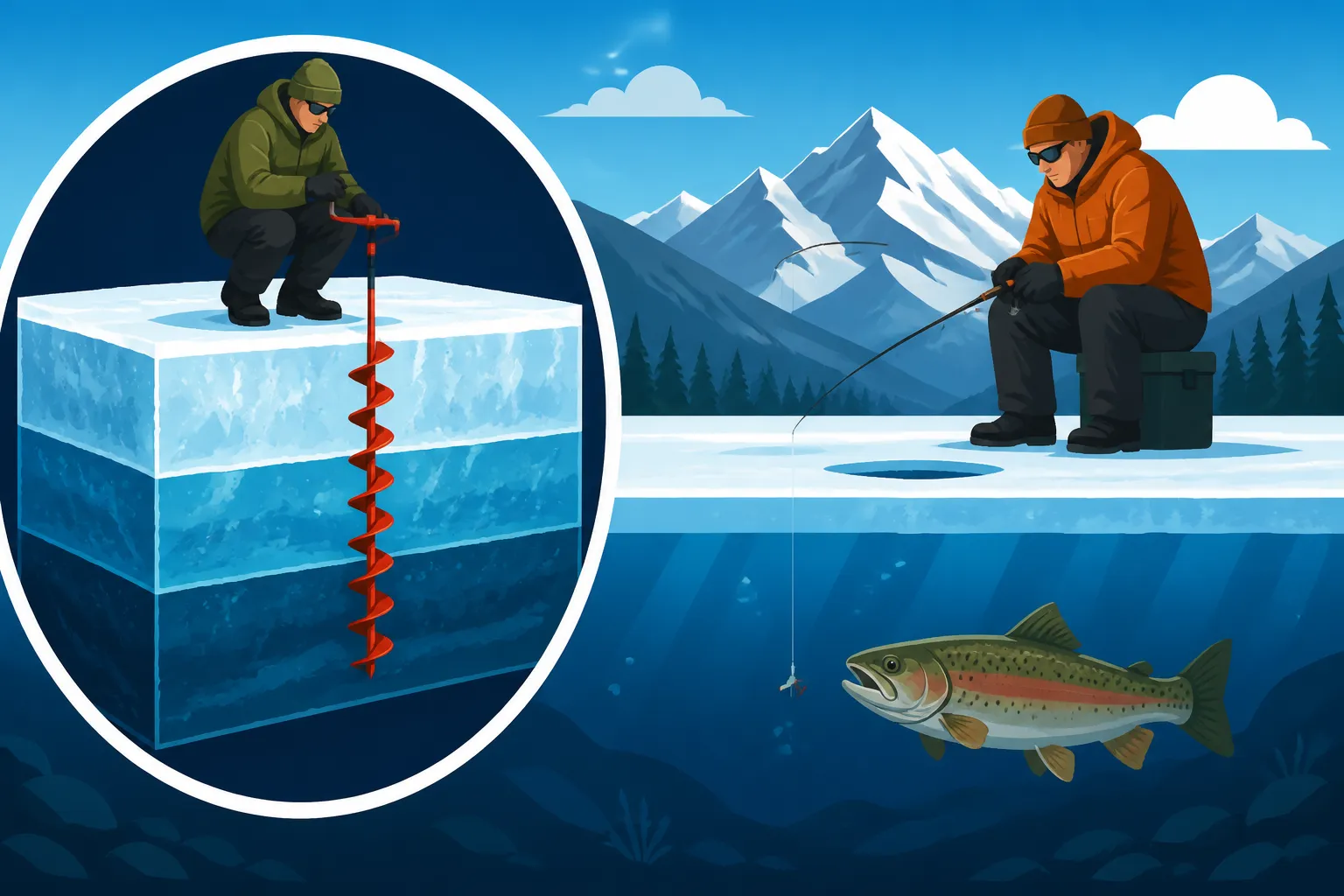
- Ice Auger: Whether it's a hand auger, a propane auger, or an electric auger, this is the most reliable way to get a precise measurement. You’ll use it to drill pilot holes and then measure the ice depth. For those looking to upgrade, consider what auger size works best for Colorado ice fishing based on the species you target.
- Tape Measure or Ruler: A standard tape measure or a simple ruler attached to a stick will allow you to accurately measure the thickness of the ice in the holes you drill. Some augers even have built-in rulers on their shaft for convenience.
- Ice Picks: These are lanyard-connected spikes worn around your neck, allowing you to grip the ice and pull yourself out if you do fall through. They're compact, inexpensive, and a true lifesaver.
- Rope/Throw Bag: A length of sturdy rope, ideally in a throw bag for easy deployment, can be used to rescue someone who has fallen through the ice without putting yourself at risk.
- Flotation Suit: While an investment, a full flotation suit offers insulation and buoyancy, significantly increasing your survival chances if you take an unexpected plunge.
Step-by-Step Measurement Process
Don't just walk out onto the ice and hope for the best. A systematic approach to checking ice thickness will dramatically increase your safety.
- Check from Shore: Before you even step foot on the ice, use your spud bar to test the ice right at the edge. Many accidents happen just yards from the bank where the ice is often weakest due to sun exposure, fluctuating water levels, or even human traffic. If it's less than 4 inches right at the edge, consider a different spot or a different day.
- Move Slowly, Test Frequently: As you venture out, take deliberate steps. Use your spud bar to test the ice every few feet in front of you. Listen for unusual sounds – loud cracks that radiate out could be a sign of stress, while a "thunk" usually indicates solid ice.
- Drill Pilot Holes: Every 10-20 yards, especially as you move into new areas or away from established paths, drill a small hole with your auger. Immediately measure the ice thickness in this hole. If it's below the minimum for your activity, retreat to safer ice.
- Pay Attention to Changes: The ice might be thick where you started, but conditions can change rapidly. Be extra cautious around inlets, outlets, bridges, docks, points, and areas with darker ice or slush. These are notorious weak spots. If the ice suddenly feels spongy, changes color, or your spud bar punches through easier, stop, re-evaluate, and consider turning back.
- Mark Safe Paths (If Necessary): If you're with a group, once a safe path has been confirmed, consider marking it with small flags or cones, especially if visibility is poor or you plan to return after dark.
This meticulous approach might seem tedious, but it's a small price to pay for a safe and enjoyable day of fishing. Imagine the peace of mind you’ll have knowing you’ve followed all the proper safety steps, whether you’re jigging for Lake Trout Through the Ice or hoping to catch some Perch in Colorado.
Factors That Affect Ice Strength in Colorado
Colorado's diverse geography and rapidly changing weather patterns mean that ice conditions can vary wildly from one lake to another, and even on the same lake within a single day. Understanding these nuanced factors is crucial for making informed safety decisions, rather than relying on a generalized "it's cold enough" assumption. The unique challenges of high-altitude lakes versus plains reservoirs demand a deeper understanding.
Snow Cover and Its Impact
Many anglers mistakenly believe that a thick blanket of snow means the ice beneath is incredibly robust. In reality, heavy snow cover can be a double-edged sword, often leaning towards the dangerous side. Snow acts as an insulator, preventing the underlying ice from growing thicker by shielding it from the cold air. This means that a lake with a consistent 6 inches of snow might have significantly thinner ice than a lake exposed to the same cold temperatures but without snow cover.
Furthermore, snow can obscure visual cues of weak ice, such as cracks, slushy areas, or dark spots indicating open water or thinness. A heavy snowfall can also add significant weight to the ice, potentially causing it to sag, crack, or even push water up through existing cracks, creating dangerous slush layers that never truly freeze solid. When you're out on the ice, be particularly wary if there’s a fresh, deep snowfall and always verify the ice thickness under the snow.
Currents, Springs, and Inlets
Moving water is the arch-nemesis of stable ice. Colorado's reservoirs are often fed by rivers and streams, and these inlets, along with dam outflows and submerged springs, create areas of constant flow that severely inhibit ice formation. The warmer, moving water erodes ice from below, creating dangerously thin spots that can be completely hidden by a layer of snow or even appear to be part of the solid ice sheet from above.
- Inlets/Outlets: These areas should always be approached with extreme caution. The strength of the current can vary, but generally, the closer you are to moving water, the thinner and weaker the ice will be.
- Submerged Springs: Many lakes and reservoirs have natural springs bubbling up from the bottom. These springs introduce slightly warmer water, which can create localized thin spots that are impossible to detect visually from the surface. The only way to find them is by consistently checking ice thickness with a spud bar or auger as you move.
- Bottle Necks/Narrow Sections: In lakes with irregular shapes, narrow channels or points that constrict water flow can create stronger currents, leading to thinner ice.
Always be hyper-aware of these features when considering How Cold Colorado Reservoirs Get Before They Ice Over and where to fish. Your best bet is to avoid these areas entirely, especially early in the season or after a warm spell.
Refrozen vs. "Black" Ice
Not all ice is created equal, and understanding the different types of ice is critical for safety. The "quality" of ice refers to its structural integrity, which is often more important than just its measured thickness.
- "Black" or Clear Ice: This is the strongest and safest type of ice. It forms directly from the freezing of calm water, creating a dense, crystalline structure. It appears dark because you can often see through it into the water below. CPW's thickness recommendations are based on this type of ice, as it offers the most reliable strength.
- White or Cloudy Ice: This ice contains trapped air bubbles or is formed from refrozen slush or snow. It's considerably weaker than clear ice of the same thickness. If the recommendations call for 4 inches of clear ice, you might need 6-8 inches of white ice for the same level of safety.
- Layered Ice: This forms when snow melts on top of existing ice and then refreezes, or when the ice partially thaws and refreezes. It often has air pockets or slush layers between the frozen layers, making it less cohesive and weaker than clear ice.
- Rotten Ice: This is ice that has deteriorated due to warm temperatures, rain, or underlying currents. It often looks honeycombed, slushy, or has a dull, grayish appearance. Rotten ice is extremely dangerous, even at thicknesses that would typically be safe for clear ice. It can collapse without warning.
Always factor in the type of ice you're standing on. When in doubt, assume the ice is weaker than it appears and err on the side of caution.
Beyond Thickness: Additional Safety Measures
While ice thickness is undeniably the most critical factor for safety, it's not the only factor. A truly safe ice fishing trip in Colorado involves a holistic approach that combines proper measurement with smart preparation, situational awareness, and a commitment to responsible practices. It’s about more than just numbers; it’s about making good judgments in dynamic conditions.
Never Fish Alone and Carry Safety Gear
This is a golden rule in ice fishing that cannot be overstated: Never fish alone. Having a buddy with you is your best insurance policy in case of an emergency. If one person falls through, the other can initiate a rescue, call for help, or at least provide comfort and warmth. Beyond a fishing partner, ensure you're equipped with specialized safety gear. We already touched on essentials like ice picks and a throw rope, but also consider a whistle to signal for help, and a fully charged cell phone (in a waterproof bag) for emergencies.
Even if you’re fishing a popular spot like Ice Fishing at Eleven Mile State Park, accidents can happen quickly, and help might not be immediately available. Proper layering of clothing to prevent hypothermia, extra dry clothes, and even an emergency blanket are also wise additions to your kit. Remember, safety isn’t just about getting out of the water; it’s about surviving after you’ve been submerged in freezing temperatures.
Knowing Your Lake and Local Conditions
Each body of water in Colorado has its own personality, especially when it comes to ice. A lake known for consistently thick ice might still have unpredictable spots. This is where local knowledge and current conditions reports become invaluable.
- Consult Local Bait Shops: These businesses are often the best source for real-time, hyper-local ice reports. They'll know which lakes are safe, where the dangerous spots are, and what the recent weather has done to the ice. They might even tell you how to set up a tip-up for lake trout or what the local bite has been like.
- Check CPW Reports: Colorado Parks and Wildlife often updates conditions on major reservoirs. While not always real-time, they provide good general guidance.
- Online Forums/Social Media: Dedicated ice fishing groups in Colorado often share up-to-the-minute reports and observations. Be discerning, but these can be a good supplement to official reports.
- Observe from Shore: Before you commit, take the time to observe the lake from different vantage points. Look for open water, slushy areas, or areas with recent cracks. Talk to anglers coming off the ice.
Never assume that because one lake is safe, another nearby one is too. Even on the same lake, conditions can change daily, especially during early and late ice seasons.
When in Doubt, Don't Go Out
Ultimately, no fish is worth risking your life for. If you have any doubt whatsoever about the safety of the ice, the answer is always to stay off. This applies if the ice seems too thin, if you're alone, if a storm is rolling in, or if you simply have a bad feeling. There will always be another day to go fishing. The peace of mind that comes from knowing you’re safe, or choosing not to go out when conditions are questionable, is far more valuable than a potential trophy catch. Prioritizing your safety, and the safety of those with you, should always be the top consideration.
Colorado Parks and Wildlife Ice Thickness Recommendations
| Activity | Recommended Minimum Clear Ice Thickness | Notes |
|---|---|---|
| Stay Off (Dangerously Thin) | Less than 2 inches | Absolutely no human or animal should be on ice this thin. |
| Single Person on Foot | 4 inches | Minimum for foot travel. Proceed with extreme caution and constant checks. This thickness is for new, clear ice. |
| Small Groups on Foot | 5 inches | For small groups walking single file. |
| Snowmobile or ATV | 8-12 inches | Use only in designated areas. Be aware of weight limits and distribution. |
| Light Truck or Car | 12-15 inches | For cars and light trucks only. Use in designated areas, often at the discretion of park staff. Requires consistent, clear ice. |
| Heavy Truck or Larger Vehicle | 18-20+ inches | Only in very specific, well-monitored situations and designated access points. |
| General Rule for White/Slushy Ice | Double the thickness | White or cloudy ice, or ice with a slush layer, is significantly weaker than clear ice. If the recommendation is 4 inches of clear ice, aim for 8 inches of white/slushy ice for equivalent strength. |
| General Rule for Cracked/Aged/Rotten Ice | Avoid Entirely | Ice that is honeycombed, showing significant signs of deterioration, or heavily cracked should be avoided regardless of measured thickness. |
Disclaimer
The information provided in this guide is for general informational purposes only and is based on official guidelines and common best practices. Ice conditions can be highly unpredictable and change rapidly. Always exercise extreme caution, use your judgment, and prioritize safety above all else when ice fishing. Neither the author nor the publisher assumes any liability for accidents or injuries that may occur from following this advice. Local conditions and regulations may vary, so always consult current Colorado Parks and Wildlife resources and local authorities before heading out onto the ice.