How Deep to Fish Streamers for Colorado Brown Trout
Fishing for brown trout in Colorado can be an incredibly rewarding experience, especially when you're slinging streamers, but it's also incredibly frustrating when you're not connecting with fish because you can't seem to get your fly down to where they're holding. It’s a common challenge: understanding how deep to present your streamer can make or break a day on the water. This comprehensive guide will break down the nuances of streamer depth, helping you understand brown trout behavior, read the water effectively, and rig your setup for success to finally put more big browns in your net.
Understanding Brown Trout Behavior and Habitat
To truly understand how deep to fish a streamer, you first need to think like a brown trout. These fish are opportunistic predators, often more aggressive and territorial than their rainbow or cutthroat cousins. They're masters of ambush, preferring spots where they can hide, conserve energy, and dart out to intercept unsuspecting prey. This means their preferred lies are almost always tied to structure and current breaks.
Where Brown Trout Hold in Rivers
Brown trout are incredibly adept at finding the "sweet spots" in a river, places that offer protection, food delivery, and minimal energy expenditure. You'll typically find them in areas with varied bottom structure and current dynamics. Think about the places where baitfish, sculpins, or crawfish might naturally hide and drift.
Deep pools, especially those with an irregular bottom or large boulders, are prime brown trout real estate. The deeper water provides security from overhead predators like eagles and ospreys, and the slower currents allow them to hold comfortably. Undercut banks are another classic hiding spot; these natural overhangs create perfect ambush points where a brown trout can lie in wait, perfectly camouflaged, ready to pounce on anything that drifts by. Logjams and root wads also offer fantastic cover, not only from predators but also from strong currents, and they often hold an abundance of insects and small fish that serve as food. Seams, where fast water meets slow water, are transitional zones that act as conveyor belts for food. Brown trout will often position themselves just on the edge of the slower water, facing into the current, waiting for a meal to be swept into their strike zone. Knowing about these preferred holding spots is crucial when you're learning about the various types of Brown Trout in Colorado, Where They're Wild.
Seasonal Movements and Feeding Habits
The time of year dramatically influences where brown trout will hold and, consequently, how deep you need to fish your streamer. Their behavior shifts with water temperature, clarity, and food availability.
In the spring, as snowmelt begins to swell the rivers, brown trout might move to the banks or into slower side channels to escape the heavy currents. As the water warms slightly after runoff, they become more active, often chasing smaller baitfish or opportunistic meals. Summer sees them spread out, but they'll still favor cooler, deeper water or shaded areas during the hottest parts of the day. Early mornings and late evenings can be excellent times to target them with streamers, as they venture out to feed more actively.
Fall, however, is often considered prime streamer fishing season for brown trout in Colorado. As water temperatures drop, brown trout become extremely aggressive, building up reserves for the upcoming spawn. They're also highly territorial, and a streamer swung through their perceived spawning redds or holding lies can often trigger a violent, protective strike, not necessarily out of hunger. This heightened aggression means they're often willing to move a little further for a meal, but still, getting that streamer into their general vicinity is key. This is why Fall Fishing in Colorado, What Changes often focuses on streamer techniques. Knowing What Brown Trout Eat as They Get Larger will also help you select the right streamer pattern and size for the season.
The Art and Science of Streamer Depth
Getting your streamer to the right depth isn't just about dropping it down; it's about presenting it naturally in the strike zone. This involves understanding what your streamer is imitating, how to read the river, and adjusting your tackle accordingly.
Matching the Hatch…or the Baitfish
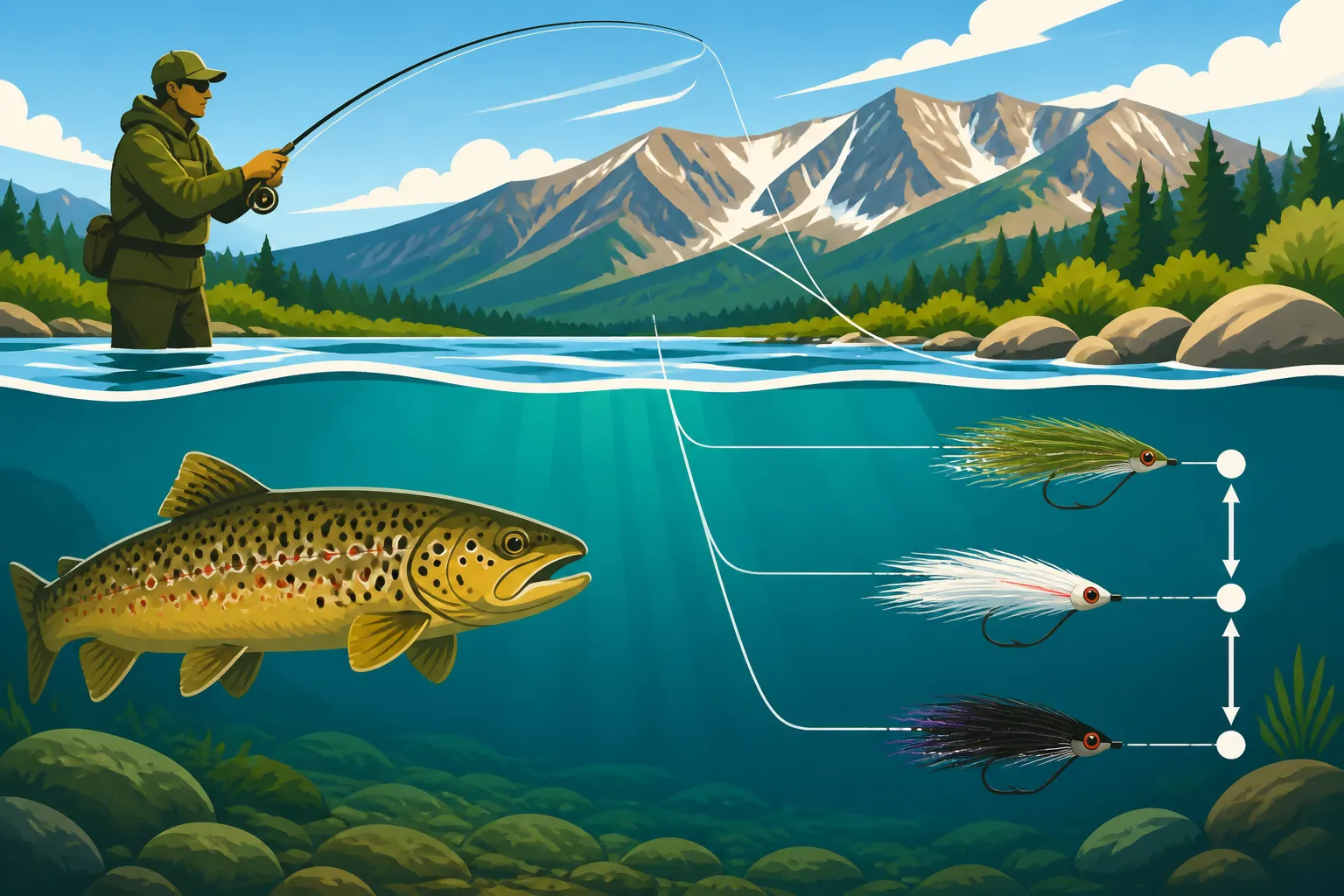
Unlike nymphing, where you might be trying to match a specific insect hatch, streamer fishing is often about imitating larger prey items – baitfish, sculpins, leeches, or crawfish. These creatures don't always hang out on the bottom. Sometimes they're cruising mid-column, sometimes hugging the bottom, and sometimes darting erratically. Your streamer's depth should reflect the natural behavior of the forage you're trying to mimic.
If you're imitating a sculpin or crawfish, which typically dwell on the riverbed, your streamer needs to be fished deep, bouncing along the bottom structure. This means you'll need to be prepared for occasional snags, but that's part of the game. If you're mimicking a baitfish darting through the water, a shallower presentation might be appropriate, especially if the trout are looking up or actively chasing prey in the upper water column. In murky water, which can often be the case after a rain or during runoff, Best Streamer Colors for Murky Colorado Water can be important, but depth is still paramount to ensure the fish can actually see your offering.
Reading the Water for Optimal Depth
Reading the water is a skill that takes years to master, but a few key principles can quickly improve your streamer depth game. The river itself will tell you where the fish are likely holding, and therefore, how deep you need to fish.
Look for areas where the current slows down, creating eddies or current seams. These are often indicators of deeper water or structure below. Observing the speed of the current is also crucial. In faster, shallower runs, your streamer might only need to sink a foot or two before it's in the strike zone. In slow, deep pools, you might need to allow your fly to sink for several seconds, or even up to 10-15 seconds, to reach the bottom. Watch for changes in water color; sometimes, slightly darker patches can indicate deeper sections. Finally, keep an eye out for surface disturbances or other anglers. If you see fish rising, streamers might not be the ticket, but if you see baitfish scattering, it’s a good sign that predatory browns are nearby. For a deeper dive into understanding these features, check out our guide on Reading Water on a Colorado Freestone River.
Adjusting Your Rig for Various Depths
The beauty of streamer fishing is its versatility. You can adjust your rig to target almost any depth. This usually comes down to your fly line and leader setup.
For shallow to moderate depths (up to 3-5 feet), a floating fly line with a stout, short leader (3-5 feet, 0X-2X fluorocarbon) and a weighted streamer is often sufficient. The weight of the streamer itself, combined with the retrieve, will dictate the depth. For deeper water or faster currents, a floating line simply won't cut it. This is where sink tips and full sinking lines become indispensable. A sink tip is a short section of sinking line spliced onto the end of a floating line, while a full sinking line is, as the name suggests, designed to sink entirely. Your choice depends on how deep you need to go and how much control you want over the presentation. On a typical Colorado river, like the South Platte or the Arkansas, having a variety of lines or sink tips on hand is essential for adapting to conditions. This allows you to fish effectively whether you're working a shallow riffle or a deep channel. If you're looking for gear, a quick search on Amazon will show you various options from brands like Scientific Anglers or Rio for sink tips and lines.
Techniques for Controlling Streamer Depth
Once you've got your line and leader sorted, the real magic happens in how you fish the streamer. Your cast, retrieve, and understanding of the current are all tools in your depth-control arsenal.
Varying Retrieves and Current Speeds
The speed of your retrieve is paramount to controlling streamer depth. A slower retrieve with a sinking line or heavily weighted streamer will allow it to sink deeper, giving it more time to get down into the strike zone. Conversely, a faster retrieve will keep it higher in the water column. The trick is to find the balance between sinking deep enough and still maintaining that enticing, lifelike movement.
Consider the current speed: In faster currents, your streamer will naturally be pushed higher. You'll need more weight, a faster sinking line, or a slower retrieve to compensate. In slower water, the streamer will sink more readily, and you might need to retrieve a bit quicker to prevent it from snagging the bottom if you're not targeting that depth. Often, a combination of varying retrieve speeds and pauses can be incredibly effective. Let the streamer sink, strip it a few times, pause to let it sink again, and repeat. Those pauses can often trigger a strike as the "injured" baitfish flutters deeper. Many anglers use a technique called "swinging" for Streamer Fishing for Colorado Brown Trout, where they cast across and slightly upstream, then let the current swing the fly down and across, retrieving as it goes. The speed of the swing and the angle of your cast will dictate the depth and speed of the fly.
Using Sink Tips and Sinking Lines
This is where the depth game truly begins for many serious streamer anglers. Sink tips and full sinking lines are specifically designed to get your fly down quickly and keep it there.
Sink tips are generally easier to cast than full sinking lines because the bulk of your line is still floating. They come in various lengths and sink rates, typically measured in IPS (inches per second). For example, a Type 3 (3 IPS) sink tip might be good for moderate depths (3-6 feet), while a Type 6 (6 IPS) or even Type 8 (8 IPS) could be necessary for deeper pools or faster currents. Popular choices include the Rio VersiTip system or various Scientific Anglers SONAR lines, which are readily available on Amazon or at local fly shops.
Full sinking lines, on the other hand, are for when you absolutely need to get deep and stay deep. They are heavier and more challenging to cast, but they offer unparalleled depth control. These lines come in different densities, from intermediate (slow sinking) to very fast sinking (Type VI or Type VII). The choice depends on the specific conditions. For example, if you're fishing a deep reservoir like Blue Mesa for lake trout, you might opt for a fast-sinking line, but for brown trout in a river, a Type III to Type V is more common. When using sinking lines, you'll need to develop a "countdown" method: cast, let it sink for a specific count (e.g., 5 seconds, 10 seconds), then begin your retrieve. This allows you to consistently hit specific depths. Mastering these lines can drastically improve your success rate for targeting trophy brown trout.
Weighting Your Streamers
Sometimes, even with a sinking line or sink tip, you need a little extra help to get your streamer into the strike zone. This is where externally weighted streamers or adding split shot comes into play. Many commercial streamers are already tied with lead eyes, coneheads, or dumbbell eyes, which provide inherent weight. Patterns like the "Sex Dungeon," "Dolly Llama," or "Woolly Bugger" often incorporate these features.
However, if your favorite streamer isn't heavy enough, you can add split shot to your leader. This is a common practice, but it's important to place the split shot strategically. Adding it too close to the fly can impede its natural movement, while too far away might cause the leader to hinge. A good rule of thumb is to place one or two smaller split shot about 10-18 inches above your fly. Experiment with different sizes of shot, starting with lighter options and increasing as needed, to avoid over-weighting and snagging. Remember, though, that some Colorado Gold Medal Waters have restrictions on weight, sometimes requiring lead-free options. The same considerations apply when you are setting up a nymph rig, where knowing What Split Shot Size Works Best in Fast Colorado Currents is crucial.
Troubleshooting Common Streamer Depth Issues
Even with the right gear and techniques, you'll inevitably encounter situations where your streamer isn't performing as expected. Learning to diagnose and fix these issues quickly is a hallmark of an experienced angler.
When Your Streamer Isn't Getting Deep Enough
The most common sign your streamer isn't getting deep enough is a lack of strikes in known deep-holding water, or watching your fly appear too high in the water column. If you can see your streamer or the line doesn't feel like it's dragging along the bottom where it should be, it’s time to make adjustments.
The first thing to consider is whether you're using the right line or sink tip for the conditions. If you're on a floating line and trying to fish a 10-foot pool, you're likely fighting a losing battle. Upgrade to a heavier sink tip or a full sinking line. Next, evaluate your casting and sinking time. Are you giving the fly enough time to sink before you start your retrieve? A longer pause after the cast allows gravity to do its work. Finally, add more weight. This can be in the form of a heavier streamer pattern, or by adding split shot to your leader. Don't be afraid to add several small split shot if necessary. Just be mindful of maintaining the streamer's action. Remember, you want to tick the bottom, not constantly snag it.
When Your Streamer Is Too Deep or Snagging
On the flip side, constantly snagging the bottom can be just as frustrating, indicating your streamer is likely too deep. While touching the bottom occasionally is a sign you're in the zone, repeated snags mean you're wasting time re-rigging and potentially leaving flies behind.
If you're snagging frequently, consider reducing the weight of your streamer or removing some split shot. You might also be using too heavy a sink tip or sinking line for the depth you're fishing. Try switching to a lighter sink tip or even an intermediate sinking line. Adjusting your retrieve speed can also help; a slightly faster retrieve will lift the streamer higher in the water column. Furthermore, analyzing your casting angle can make a difference. Casting more downstream can keep the fly up, while casting more upstream and across allows more time for the fly to sink. Finally, sometimes it's just the water. If you're in an area with a lot of debris, rocks, or underwater snags, you might need to adjust your target depth slightly higher or move to a different spot. Understanding High Water Tactics During Colorado's Runoff can also help, as high water often means different snags and bottom contours.
Here’s a quick guide to help you choose the right line setup for varying depths:
| Line/Tip Type | Recommended Depth Range | Ideal Conditions | Pros | Cons |
|---|---|---|---|---|
| Floating Line + Weighted Streamer | 1-4 feet | Shallow runs, riffles, wary fish looking up | Easiest to cast, subtle presentation | Limited depth, hard to get deep in fast water |
| Intermediate Sink Tip (Type I-III) | 3-6 feet | Moderate depths, slower currents, clear water | Good balance of castability and sink rate | Might not get deep enough in fast/deep water |
| Medium Sink Tip (Type III-V) | 5-10 feet | Deeper runs, moderate to fast currents, pools | Versatile for many river situations | Can be harder to mend, slightly heavier to cast |
| Fast Sink Tip (Type VI-VIII) | 8-15+ feet | Deepest pools, strong currents, reservoir edges | Gets down fast, stays deep | Harder to cast, less feel, more snags |
| Full Sinking Line | 10-20+ feet | Extremely deep water, large reservoirs, vertical jigging | Maximum depth control, consistent sink | Most challenging to cast, difficult to mend, heavy |
Ultimately, successful streamer fishing for brown trout in Colorado is about constant adaptation. Pay attention to the water, feel for the bottom, and don't be afraid to experiment with your line, weight, and retrieve. The reward of a massive brown trout slamming your streamer is well worth the effort! If you're looking for gear, most local fly shops or larger retailers like Cabela's or Sportsman's Warehouse, or even online on Amazon, will have a wide selection of these lines and tips to choose from. When you're considering your rod setup, think about what Best Rod Weight for Colorado Trout Fishing would be for streamer fishing – generally, a 6 or 7-weight rod is ideal.
Disclaimer
Please note that fishing conditions and regulations in Colorado can change. Always consult the most current Colorado Parks and Wildlife regulations before heading out on your fishing trip. The information provided here is for general guidance and educational purposes only.