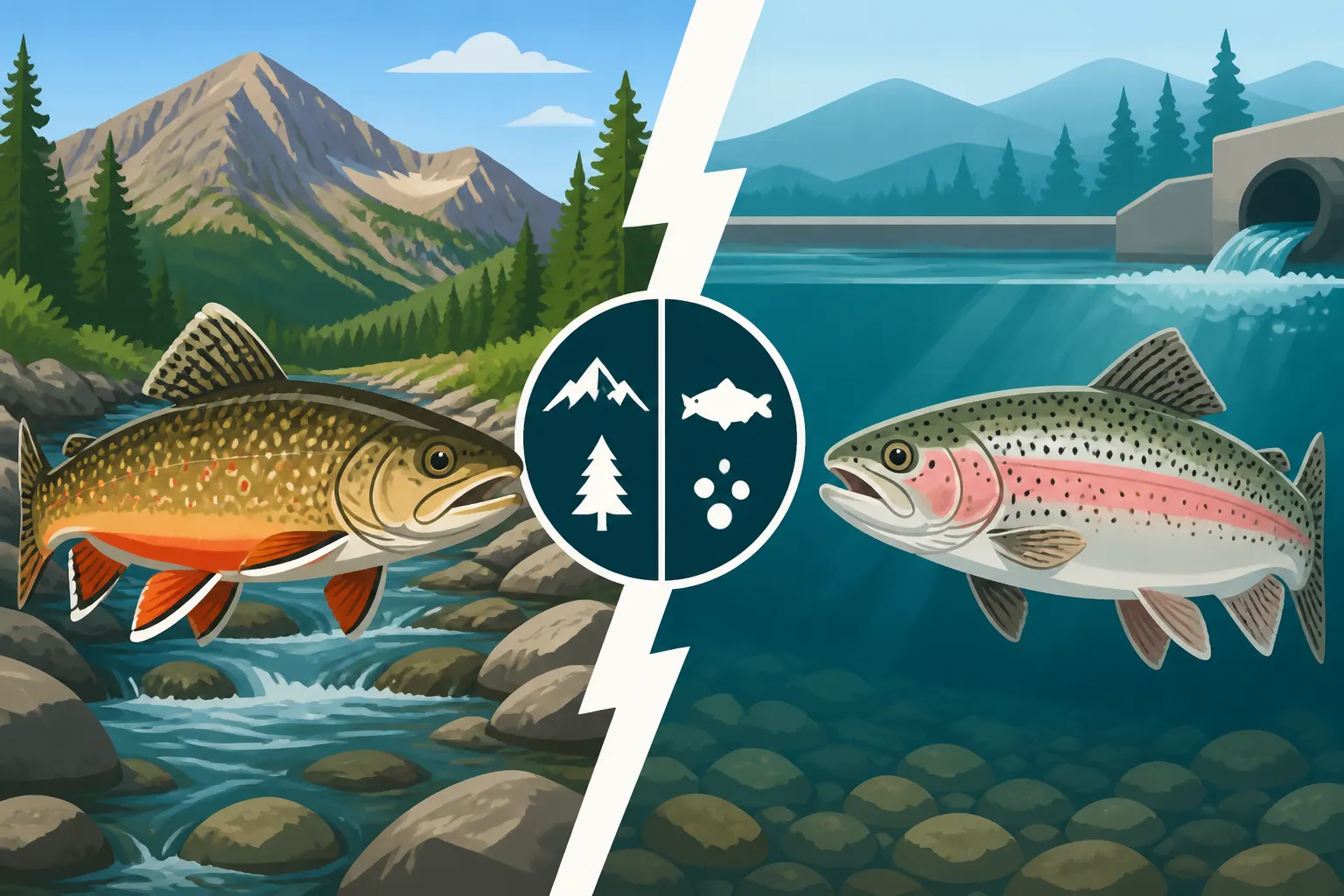
Identifying Colorado’s Native vs Stocked Trout
It's incredibly frustrating when you're out on a beautiful Colorado river or high-mountain lake, you reel in a gorgeous trout, and then you're left wondering: is this a native beauty, a wild-spawned fish, or one of the many wonderful trout stocked by our state? The difference isn't just academic; it can seriously impact your daily bag limit and, frankly, your peace of mind knowing you're protecting our precious natural resources. This guide will walk you through the distinct signs and subtle clues that help you confidently identify Colorado's native and stocked trout.
Why Differentiating Native and Stocked Trout Matters in Colorado
For many anglers, a fish is a fish, and the joy of a tug on the line is universal. But in Colorado, especially with our incredible native cutthroat populations and dedicated conservation efforts, knowing the difference between a native trout and a stocked one is more than just a fun fact. It's a critical part of responsible angling and protecting the very waters we cherish.
Conservation and Bag Limits
Let's be real, no one wants to accidentally break a fishing regulation. Colorado Parks and Wildlife (CPW) has very specific rules for different species, particularly our native cutthroat trout. In many designated native trout waters, you might find regulations that require immediate release, barbless hooks, or specific length limits that differ wildly from other areas. If you can't tell a greenback cutthroat from a rainbow, you might unwittingly keep a fish that's protected or release one you could have kept. This distinction is vital for conservation because our native species often have precarious populations that require careful management to thrive. Understanding the rules for different species and the areas where they live is paramount. You can find more details on Colorado Fishing Regulations Every Angler Should Know and Colorado Bag and Possession Limits by Species. It's a heavy responsibility, but it's also a badge of honor for anglers who care deeply about the future of our fisheries.
Understanding Fish Behavior and Habitat
Think about it: a fish that grew up in a hatchery pond, fed pellets, and then dumped into a new environment is going to behave differently than a fish born and raised in the wild currents of a mountain stream. Stocked trout, especially recent additions, often hang out near the stocking points. They might be less wary of humans, and their feeding habits are often less selective, sometimes even taking an artificial fly or lure they wouldn't encounter in nature. Wild trout, on the other hand, are survivors. They're more attuned to their environment, highly selective feeders, and much more likely to seek out natural cover and avoid human presence. Knowing these behavioral differences can help you refine your fishing techniques and even predict where you might find different types of trout, making you a much more effective angler. It also helps you appreciate the wildness of a native fish, a true testament to its natural resilience.
Key Physical Characteristics to Look For
When you have a fish in hand, the most immediate clues to its origin are right there in its physical appearance. It's like reading a book; the pages tell a story if you know what to look for. These are the details that separate the hatchery-raised from the wild-born.
Fin Condition and Coloration
One of the most tell-tale signs of a stocked trout is the condition of its fins. Hatchery environments, with their concrete raceways and high fish densities, often lead to "fin erosion." This means the fins, especially the dorsal, pectoral, and caudal (tail) fins, can appear blunt, tattered, or noticeably shorter and more rounded than those of a wild fish. You might even see white or frayed edges. Wild trout, conversely, almost always have pristine, sharp, and perfectly formed fins. Their fins are typically larger relative to their body size, providing the necessary leverage for navigating fast currents.
Beyond fin condition, look at the overall color. Stocked trout tend to be paler, with less vibrant and sometimes less defined spots. Their bellies might even appear whiter due to less exposure to natural forage and varied light conditions. Wild trout, especially those thriving in pristine waters, boast brilliant, deep colors. Their spots are usually sharper and more distinct, and their coloration adapts to their environment – think of a brook trout pulled from a cold, dark beaver pond versus a rainbow from a sunny freestone river. The deep crimson stripe of a wild rainbow or the vivid red slashes under the jaw of a native cutthroat are almost always more intense than those on their hatchery-raised counterparts.
Body Shape and Overall Condition
The body shape of a trout can also offer significant clues. Stocked fish, particularly those recently released, often have a more uniform, "football-like" or plump appearance. This is due to a consistent diet of high-protein pellets in the hatchery. While they might look well-fed, their body can sometimes appear less streamlined, and they might even have small deformities from crowded conditions. Their scales might also be slightly abraded from rubbing against other fish or concrete.
Wild trout, in contrast, are usually sleek, lean, and incredibly muscular. Their bodies are built for fighting currents, escaping predators, and chasing down natural prey. They often have a more athletic, torpedo-like shape. Their scales are typically smooth and intact, reflecting a life of freedom and natural challenges. When you handle a truly wild trout, you'll feel the power in its tail and the firm muscle tone that comes from constantly navigating a dynamic river or lake ecosystem. It's a subtle difference, but once you've felt it a few times, it becomes unmistakable.
Understanding Colorado's Native Trout
Colorado is home to some truly magnificent native trout species, each with a unique story and critical conservation needs. Learning to identify these fish isn't just about following rules; it's about connecting with the natural heritage of our state's waterways.
Greenback Cutthroat Trout
The Greenback Cutthroat Trout (Oncorhynchus clarkii stomias) is Colorado's state fish, and its story is one of dramatic decline and inspiring recovery. Historically, these fish were widespread on the eastern plains of Colorado in the South Platte River drainage. They are characterized by their relatively large, dark spots concentrated towards the tail, a distinct green or bronze hue on their back, and, of course, the iconic red or orange "cutthroat" slash under their jaw. What makes them truly special is their genetic purity; many populations today are the result of intense conservation efforts to find and re-establish genetically pure strains. You absolutely need to know how to identify these fish because, in most waters where they exist, they are strictly catch-and-release, or even closed to fishing entirely, to aid their recovery. Misidentification could have serious consequences for both the angler and the species. Delve deeper into their journey by reading Greenback Cutthroat Trout Recovery in Colorado.
Colorado River Cutthroat Trout
Found primarily on the western slope of Colorado, the Colorado River Cutthroat Trout (Oncorhynchus clarkii pleuriticus) is another vital native subspecies. Like all cutthroats, it has the characteristic red slash, but its coloration tends to be more golden-yellow or copper, often with a fine spotting pattern that can be quite dense across its body and tail. They typically inhabit colder, clear headwater streams and high-elevation lakes within the Colorado River basin. These fish are less tolerant of warmer water and habitat degradation, making their presence a good indicator of healthy, pristine environments. Identifying them correctly is crucial because many of the streams they call home are part of ongoing restoration projects, and special regulations often apply to protect these vulnerable populations. Knowing Colorado River Cutthroat Trout, Where to Find Them is key to targeting and appreciating this native gem responsibly.
Rio Grande Cutthroat Trout
Venturing to the southern part of Colorado, primarily in the San Luis Valley and the Rio Grande River basin, you'll find the Rio Grande Cutthroat Trout (Oncorhynchus clarkii virginalis). This subspecies shares the general cutthroat characteristics – the jaw slash and an olive-green to silvery body – but often has a more uniform spotting pattern that is lighter and more evenly distributed over its body compared to the Greenback or Colorado River cutthroats. The unique genetics of the Rio Grande Cutthroat are a testament to the diverse ecosystems of Colorado. These fish have adapted to the specific conditions of the Rio Grande drainage. As with the other native cutthroats, their populations are often fragile, and anglers have a responsibility to know their appearance and the specific regulations that apply to these waters to ensure their continued survival. Learning about Rio Grande Cutthroat Trout in the San Luis Valley can help you understand their specific needs and habitats.
Recognizing Colorado's Stocked Trout
While native trout hold a special place in our hearts for their wildness and heritage, stocked trout play an incredibly important role in providing abundant fishing opportunities across Colorado. They are the backbone of many urban fisheries and popular lakes, making fishing accessible for everyone. But just because they're stocked doesn't mean they aren't worth admiring, and identifying them is still important for proper regulation adherence.
Rainbow Trout and "Stockie" Indicators
Rainbow trout are undoubtedly the most common species you'll encounter in Colorado, largely due to extensive stocking programs. If you're fishing a community pond in Denver, a popular reservoir along the Front Range, or even many mountain lakes that see heavy angling pressure, chances are you're catching a stocked rainbow. The "stockie" indicators are often quite pronounced. As mentioned earlier, look for those tell-tale short, rounded, or eroded fins. The dorsal fin, in particular, often shows signs of being rubbed against concrete raceways. Their colors might be muted, lacking the vibrant iridescence of a wild rainbow. You might also notice a more uniform size among the fish caught in a particular area, suggesting they came from the same stocking batch.
These stocked rainbows are typically very eager to bite, having been conditioned to feed consistently in a hatchery. They'll often respond well to a wide variety of baits, lures, and flies, making them an excellent target for beginners or those just looking to bend a rod. CPW does an amazing job stocking these fish to ensure everyone has a chance to catch a trout, and knowing you've landed a "stockie" often means you can confidently keep a few for dinner within the legal limits. For more on where these fish end up, check out Rainbow Trout in Colorado, Where They're Stocked.
Brown Trout and Brook Trout
While many of Colorado's brown trout and brook trout populations are wild and self-sustaining, particularly in smaller streams and high-country lakes, both species are also stocked in certain areas to enhance angling opportunities. Identifying a stocked brown or brook trout follows similar principles to rainbows, but with some nuanced differences.
Brown Trout: Wild brown trout are known for their incredible wariness and striking beauty, often displaying brilliant gold, bronze, and dark brown hues with red and black spots, some with light halos. Their fins are typically pristine and powerful. Stocked brown trout, if they haven't been in the wild long, might show the same fin erosion and paler coloration as stocked rainbows. However, brown trout are feistier than rainbows, and even stocked browns tend to "go wild" faster, adapting to natural forage and quickly improving their fin condition and coloration once released into a river or lake. It can be challenging to distinguish a brown trout that has been stocked for a while from a truly wild one, but often, the size and health of its fins remain a key indicator. You can learn more about these fascinating fish by reading Brown Trout in Colorado, Where They're Wild.
Brook Trout: Brook trout, with their distinctive worm-like markings (vermiculations) on their backs and vibrant red and yellow spots often ringed with blue halos, are a favorite in many high-country streams and lakes. Most brook trout populations in Colorado are wild and self-sustaining, reproducing readily even in small waters. However, CPW does stock them in some specific high-altitude lakes that lack natural reproduction or need a boost. A stocked brook trout might exhibit those same fin wear signs, but because brook trout are generally smaller and often found in more pristine environments even when stocked, the signs might be less obvious than on a large stocked rainbow. The habitat itself often tells you more: if you're pulling brook trout from a remote, high-alpine lake that's difficult to access, they're likely wild. If you're catching them in an easily accessible pond that's known for stockings, they might be hatchery-raised. Explore their preferred habitats in Brook Trout in Colorado's High Country.
The Role of Fin Clips and Genetic Testing
Beyond visual cues, wildlife agencies like Colorado Parks and Wildlife employ more scientific methods to track and manage fish populations. These methods provide concrete evidence that can sometimes be the only definitive way to differentiate native from stocked fish, especially when visual signs are ambiguous.
Identifying Fin Clips
Fin clipping is a common practice used by fish hatcheries and wildlife biologists to mark fish for identification. A small portion of a fin – often the adipose fin (a small, fleshy fin between the dorsal and tail fins), or a pectoral or pelvic fin – is removed when the fish are young. This clip is permanent and harmless to the fish. If you catch a trout with a missing or partially removed fin, it's a very strong indicator that it's a stocked fish. The type and location of the clip can sometimes even tell biologists when and where that fish was stocked, or if it's part of a specific research project.
For anglers, spotting a fin clip simplifies the identification process immensely. If you see a fin clip, you can almost always assume it's a stocked fish, and thus, certain native-specific regulations usually won't apply. However, it's still crucial to be familiar with the regulations of the specific water body you're fishing, as some waters have unique rules that apply regardless of fin clips. Keep an eye out for these subtle but intentional markings; they are direct communication from our wildlife managers. For a deeper dive, check out What Fin Clips Tell You About a Stocked Trout. If you want to dive into fishing literature to identify fin clips or fish species, you can find many excellent field guides on sites like Amazon that show diagrams and explanations.
The Importance of Genetic Integrity
While fin clips offer a visual marker for stocked fish, the concept of genetic integrity is paramount when discussing native trout. This is especially true for our cutthroat subspecies. In the past, various cutthroat subspecies and even rainbow trout were sometimes stocked in the same waters, leading to interbreeding and the creation of "cutbows" (rainbow-cutthroat hybrids) or genetic dilution of pure native strains. This interbreeding is a serious threat to native populations, as it can erode the unique genetic adaptations that native fish have developed over millennia to survive in their specific environments.
Today, CPW and other conservation groups use genetic testing to identify pure native strains and guide reintroduction efforts. They collect tissue samples from fish (often a tiny fin clip that doesn't harm the fish) and analyze their DNA to determine their genetic makeup. This scientific approach helps ensure that when native trout are stocked or reintroduced into a stream, they are genetically pure and will contribute to the long-term survival of the species, rather than further diluting the native gene pool. For anglers, while you won't be doing genetic testing in the field, understanding its importance highlights why strict regulations exist in native trout recovery waters and why it's so critical to accurately identify these fish. Learn more about the conservation challenges in Why Interbreeding Threatens Native Cutthroat Populations.
| Characteristic | Stocked Trout (General) | Wild/Native Trout (General) |
|---|---|---|
| Fins | Often blunt, rounded, frayed, or eroded; sometimes clipped. | Pristine, sharp, well-formed, and proportional to body size. |
| Coloration | Generally paler, less vibrant; spots may be faded or less defined. | Vibrant, rich colors; distinct, crisp spots; often adapted to habitat. |
| Body Shape | Plump, uniform, sometimes less streamlined; "football" shape. | Lean, muscular, streamlined, athletic build. |
| Spots | May be irregular, sparse, or faded. | Defined patterns; unique to species (e.g., Greenback, CRC, RGC). |
| Cutthroat Slash | Present on cutthroat hybrids (cutbows), but may be less vivid. | Distinct, vibrant red/orange slash under the jaw on pure cutthroats. |
| Scales | Sometimes show slight abrasion. | Smooth, intact. |
| Behavior (initial) | Less wary, may congregate near stocking points, less selective. | Wary, seek natural cover, highly selective feeders. |
Practical Tips for Anglers in the Field
Being able to tell the difference between a native and a stocked trout truly elevates your angling experience. It's about becoming a better steward of the environment and a more knowledgeable participant in the sport. Here are some actionable tips you can use every time you hit the water.
Observe Your Location and Water Type
Before you even make your first cast, gather some intel about where you are fishing. Is it a small, high-elevation stream nestled deep in a wilderness area? Or is it a readily accessible urban pond, a popular reservoir, or a major river near a town? Location often provides a huge clue. Waters that are difficult to access, especially at higher elevations, are more likely to hold wild, self-sustaining populations, including native cutthroat trout. Popular, easily accessed waters, particularly those near urban centers, are almost universally managed through stocking programs to meet high demand.
Also, pay attention to the specific water type. Is it a cold, clear tailwater below a dam, a freestone river with swift currents, or a still-water lake? Each environment favors certain species and management strategies. For instance, many of Colorado's Gold Medal Waters, while often holding large wild trout, also have strict regulations that demand careful identification. Knowing the general management strategy for a specific body of water, often detailed in the annual Colorado Fishing Brochure, can give you a strong head start on identification. Don't forget to check out Colorado Gold Medal Water Regulations Explained to understand the nuances of these prime fishing locations.
Carry a Field Guide or Use Apps
No one expects you to be a walking encyclopedia of fish identification! That's why having a reliable reference tool with you in the field is incredibly helpful. A small, waterproof field guide specifically focused on Colorado's fish species can be a game-changer. These guides typically feature detailed illustrations or photographs, descriptions of key identification features, and often include information on habitat and range. You can often find excellent field guides like these on Amazon, ready to slip into your vest or pack.
Alternatively, many smartphone apps are available that offer fish identification features, often with community-sourced photos and local information. While cell service can be spotty in remote areas, for many popular fishing spots, these apps can be a quick and convenient way to double-check your observations. Just remember that technology isn't foolproof, and a good old-fashioned printed guide often has more detailed drawings for subtle differences. Having a physical book from Amazon in your bag means you're never dependent on a signal.
When in Doubt, Practice Catch and Release
This is perhaps the most important rule of thumb, especially when you're fishing in waters known to hold native or sensitive trout populations. If you catch a fish and you're truly uncertain whether it's a native cutthroat, a hybrid, or a stocked rainbow, the safest and most responsible course of action is to carefully release it. This simple act minimizes the risk of inadvertently violating regulations or harming a vulnerable population.
Practicing careful catch and release, using appropriate handling techniques (wet hands, minimal time out of water, proper de-hooking), ensures that the fish has the best chance of survival. Many waters, particularly those managed for native cutthroat recovery, are designated as catch-and-release only for specific species. Always verify the regulations for the specific water you are fishing before deciding to keep any fish. When in doubt, let it swim to fight another day. It's a small sacrifice for the long-term health of our fisheries. You can find more specific guidelines by looking into Catch-and-Release Rules on Colorado's Cutthroat Waters.
Disclaimer
This article is for general informational purposes only and does not constitute professional advice. Laws, prices and regulations vary by location and change over time. Consult a qualified professional for guidance on your specific situation.